The workbench · free build, work shown
How to build an AI that knows your business and won’t make things up.
Six rules that turn a chatbot into something your team can actually trust.
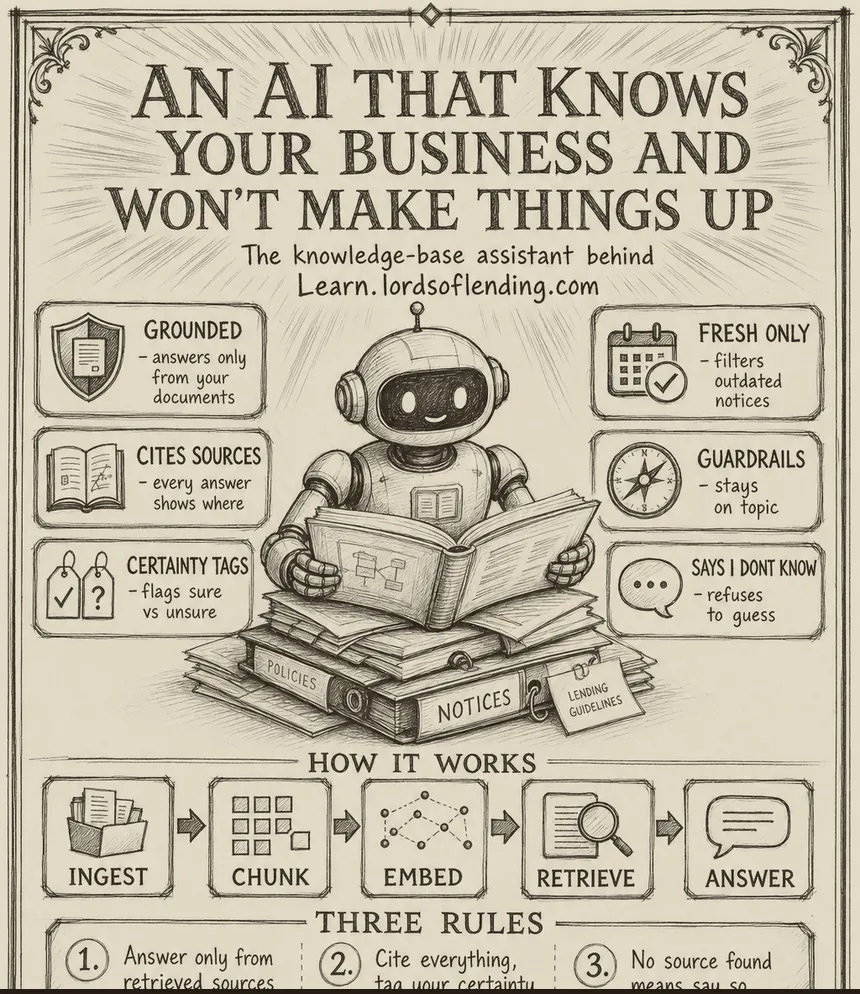
The number one fear about AI is that it makes things up. So I built an assistant that answers only from a real knowledge base and says I do not know when the answer is not there. It is live, answering questions about a few hundred pages of dense regulatory material. Here is how it works.
The trick is not a smarter model. It is discipline. Six rules turn a chatbot into something your team can actually trust.
- Ground every answer in your own documents. The AI does not answer from its training. It first pulls the relevant passages out of your documents, then answers only from those. That retrieval step is the whole game.
- Cite the source. Every answer shows exactly which document and section it came from, so anyone can verify it in one click. No citation, no trust.
- Tag the certainty. The assistant marks how sure it is, so a shaky answer gets flagged instead of stated like gospel.
- Filter out the stale stuff. Rules get replaced. The assistant filters out anything marked outdated or rescinded, so it never quotes a rule that no longer applies. Your version: give every document a date and a status.
- Put up guardrails. It stays on its topic and politely refuses questions outside its knowledge, instead of wandering off and guessing.
- Let it say I do not know. When the search comes back empty, it says so, plainly. That single behavior is the difference between a tool your team relies on and a toy nobody opens twice.
Any business with a manual, a policy set, a price list, or a product catalog can have this. Support that answers from your real docs. Onboarding that never guesses. The blueprint above is the whole architecture, free to copy.
From a live document-grounded assistant. Everything described here is something I actually run; nothing on this bench is theoretical.