The workbench · free build, work shown
How to give AI memory with no vector database.
Two rolling summaries and ordinary Postgres, a real memory for pennies.
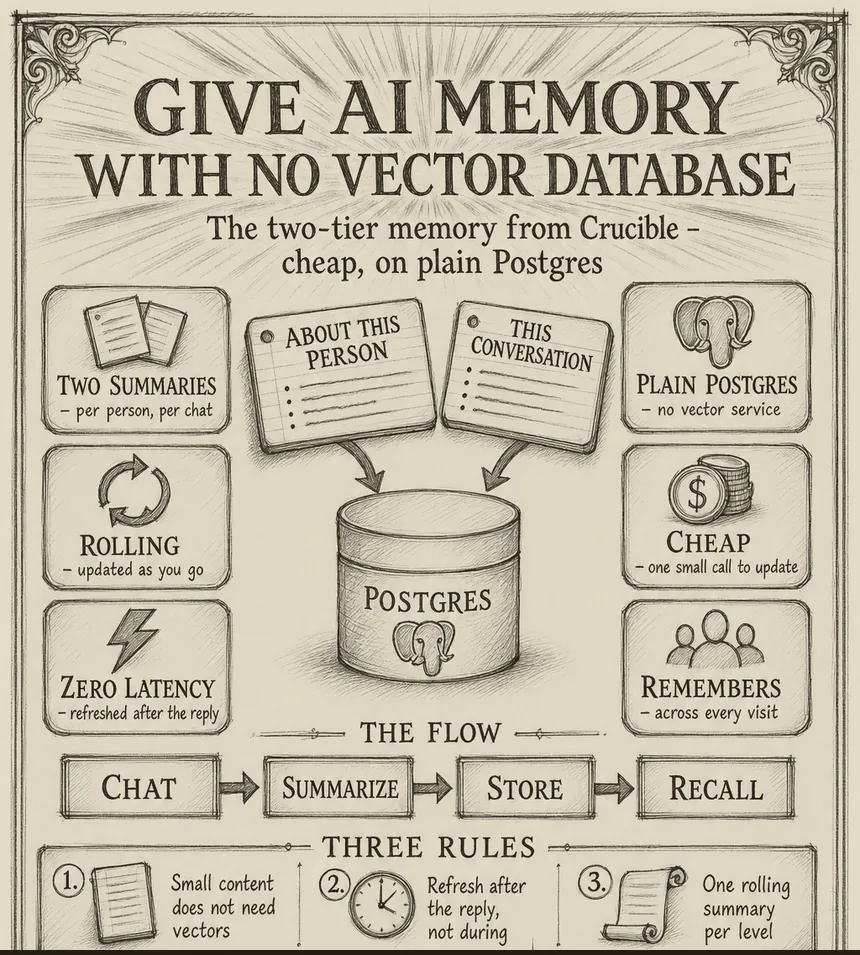
Everyone says you need a vector database to give AI memory. For most businesses, you do not. I gave an assistant a real memory using two plain text summaries and ordinary Postgres. Here is how.
Six parts, and it costs pennies to run.
- Keep two summaries. One rolling summary about the person, and one about the current conversation. That is the whole memory.
- Roll them forward. As the conversation goes, the summaries update to include what is new, so they stay current without growing forever.
- Refresh after the reply, not during. The update runs right after the AI answers, so the user never waits on it. Zero added latency.
- Store it in plain Postgres. Two text fields in a normal database. No vector service to run, learn, or pay for.
- Keep updates cheap. Refreshing a summary is one small, cheap model call, not a re-index of everything.
- Remember across visits. Next time the person shows up, the assistant already knows them, because the summary was waiting.
If your knowledge is small enough to summarize, and for most businesses it is, you do not need the heavy machinery. This is the cheap, clean way. Two text fields and a small prompt, the blueprint above is all of it.
From the Lords of Destiny build. Everything described here is something I actually run; nothing on this bench is theoretical.