The workbench · free build, work shown
How to replace an expert’s memory with a rules file.
Turn the knowledge in one person’s head into a plain file anyone can run.
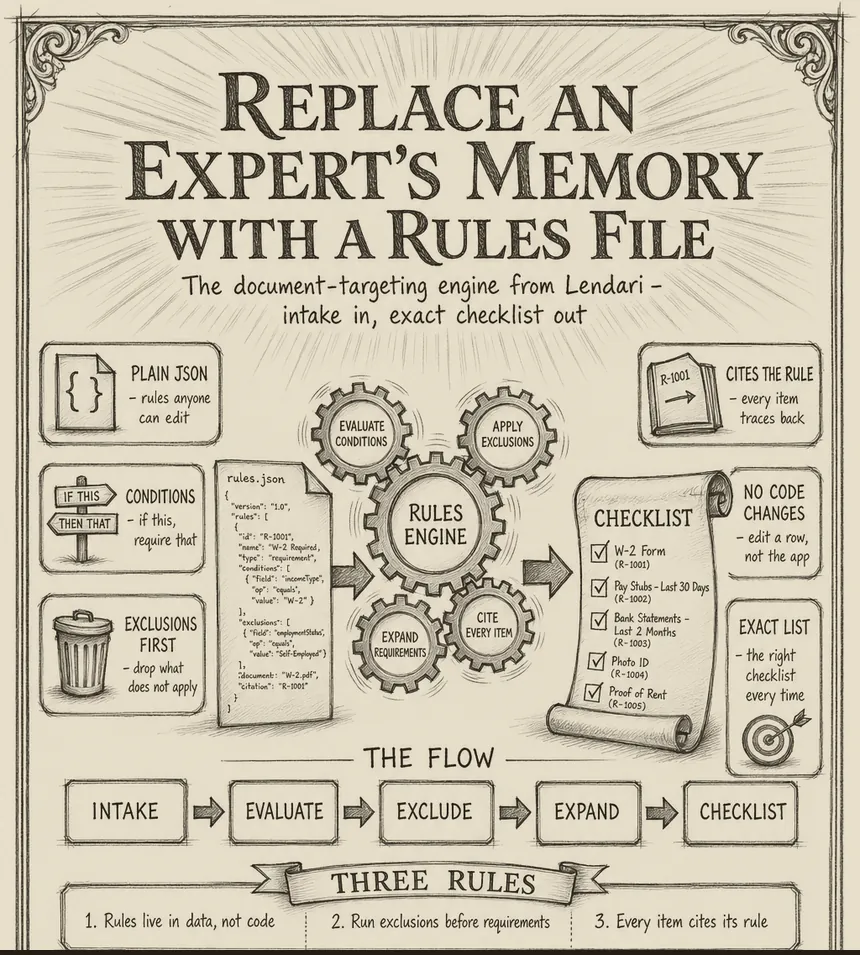
A lot of small businesses run on one person’s head. They know exactly what a job needs, and when they are out, everything stalls. I turned that knowledge into a plain rules file anyone can run. Here is how.
Six moves, and the first one is the whole idea.
- Put the rules in data, not code. Every rule lives in a plain file: if the job has real estate, require the appraisal. If there are two owners, require two of these. A non-programmer can read and edit it.
- Evaluate against the intake. A small loop reads the customer’s answers and runs every rule, building the exact list for that specific case.
- Run exclusions first. Before adding what is required, drop what does not apply. Order matters, and getting it backwards is the classic bug.
- Cite the rule behind every item. Each item on the list points back to the rule that produced it, so you can always answer why is this here.
- Change a row, not the app. When the process changes, you edit the rules file, not the software. No developer, no deploy.
- Get the exact list every time. Messy intake in, precise checklist out, the same way every time, without leaning on anyone’s memory.
Any what do we need from you to start workflow runs on this: contractors and permits, accountants and tax docs, agencies and onboarding. The six moves above are the whole engine, take them.
From the Lendari build. Everything described here is something I actually run; nothing on this bench is theoretical.