The workbench · free build, work shown
How to give your AI a memory that actually remembers.
Store what it learns by meaning, so it recalls the right thing however you word it.
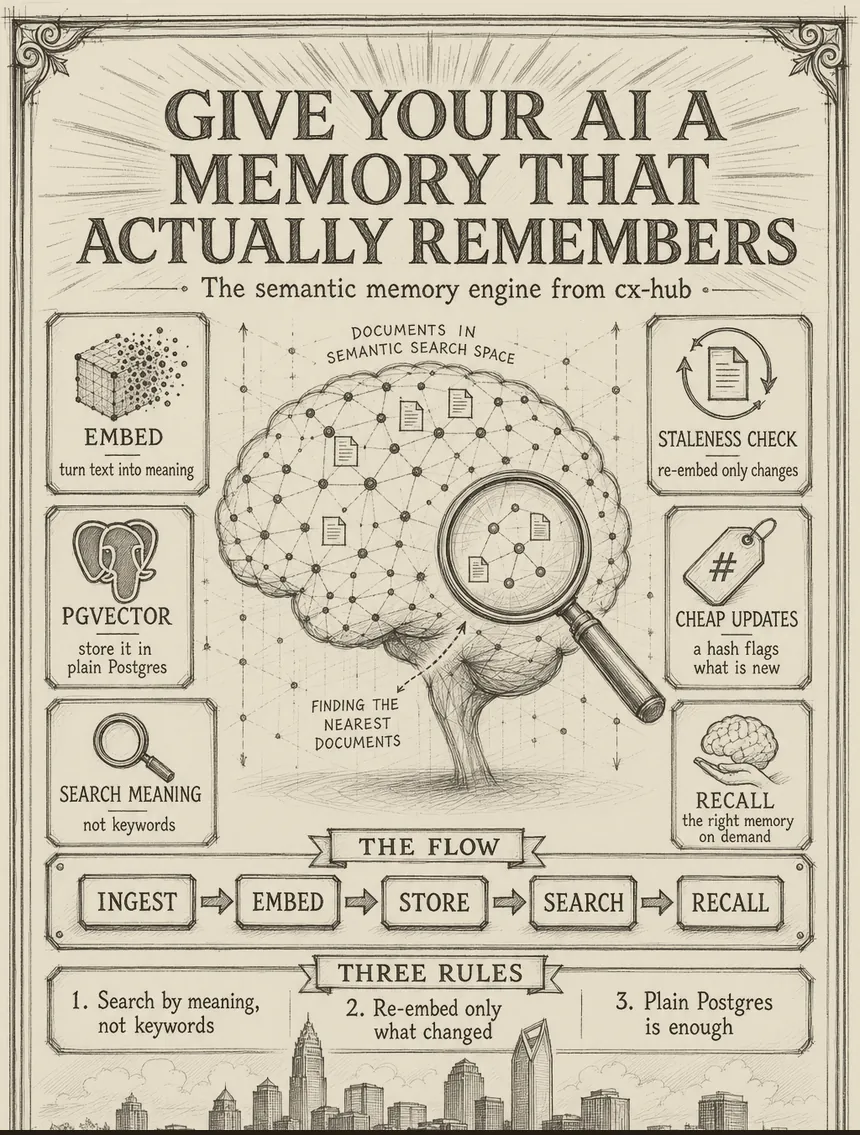
A plain chatbot forgets everything the moment the chat closes. The fix is a memory that stores what it learns by meaning, so it can recall the right thing later even when you word it differently. Here is how I built one on plain Postgres.
Six parts, no exotic database required.
- Turn text into meaning. Each piece of text runs through an embedding model that turns it into numbers capturing what it means, not just the words.
- Store it in plain Postgres. Those numbers go into a normal Postgres database with the pgvector extension. No expensive vector service needed.
- Search by meaning. When you recall something, you search by meaning, so what did we agree on pricing finds the right note even if it never used those words.
- Only re-embed what changed. A hash of each document tells the system what actually changed, so it re-embeds just those, not the whole library.
- Keep updates cheap. That staleness check is the difference between a memory that costs pennies to maintain and one that costs a fortune.
- Recall on demand. The assistant pulls the most relevant memories into any answer, so it feels like it actually knows your business.
This is the building block under any assistant that should remember a customer, a project, or a policy across visits. The blueprint above is the full architecture, ready to build on.
From a production operations assistant. Everything described here is something I actually run; nothing on this bench is theoretical.